WARURU is a physics demolition sandbox for your browser. Pick a building and take it down with explosives, weapons, or a full demolition method. Development began on September 30, the game went live on EchoPlayroom on October 2, and today it arrived on itch.io. This is a short record of those first five days.
From a neighborhood to one building
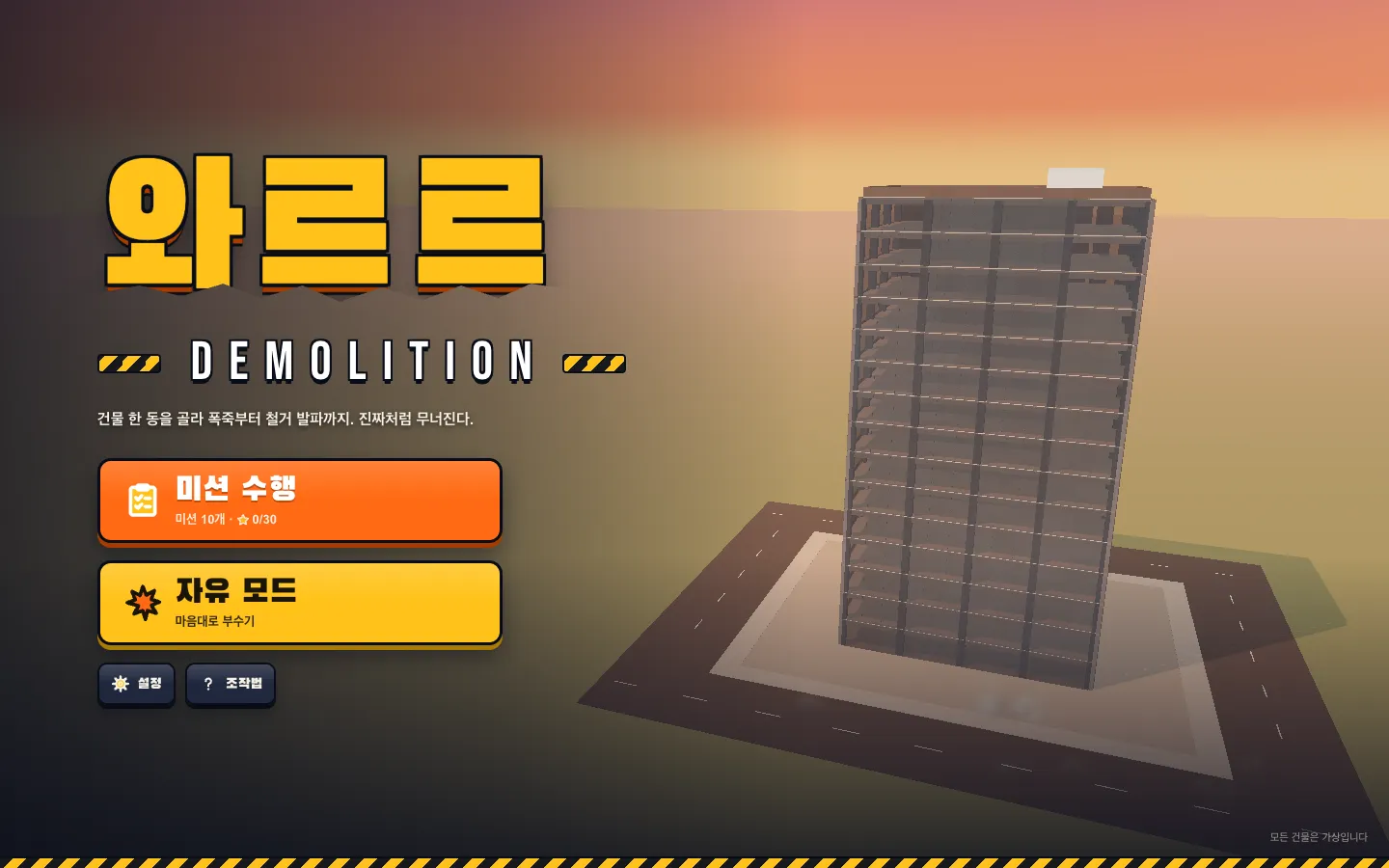
The original idea was to build an entire fictional neighborhood in 3D and let you destroy it. Soon after starting, I narrowed that down to one building. Instead of making the neighborhood bigger, I wanted the way a building collapsed to change depending on where you hit it. On October 3, I also changed the name from Demolition Lab to WARURU. “와르르” is the Korean sound of things crumbling down all at once; WARURU writes that sound in English.
How the collapse works
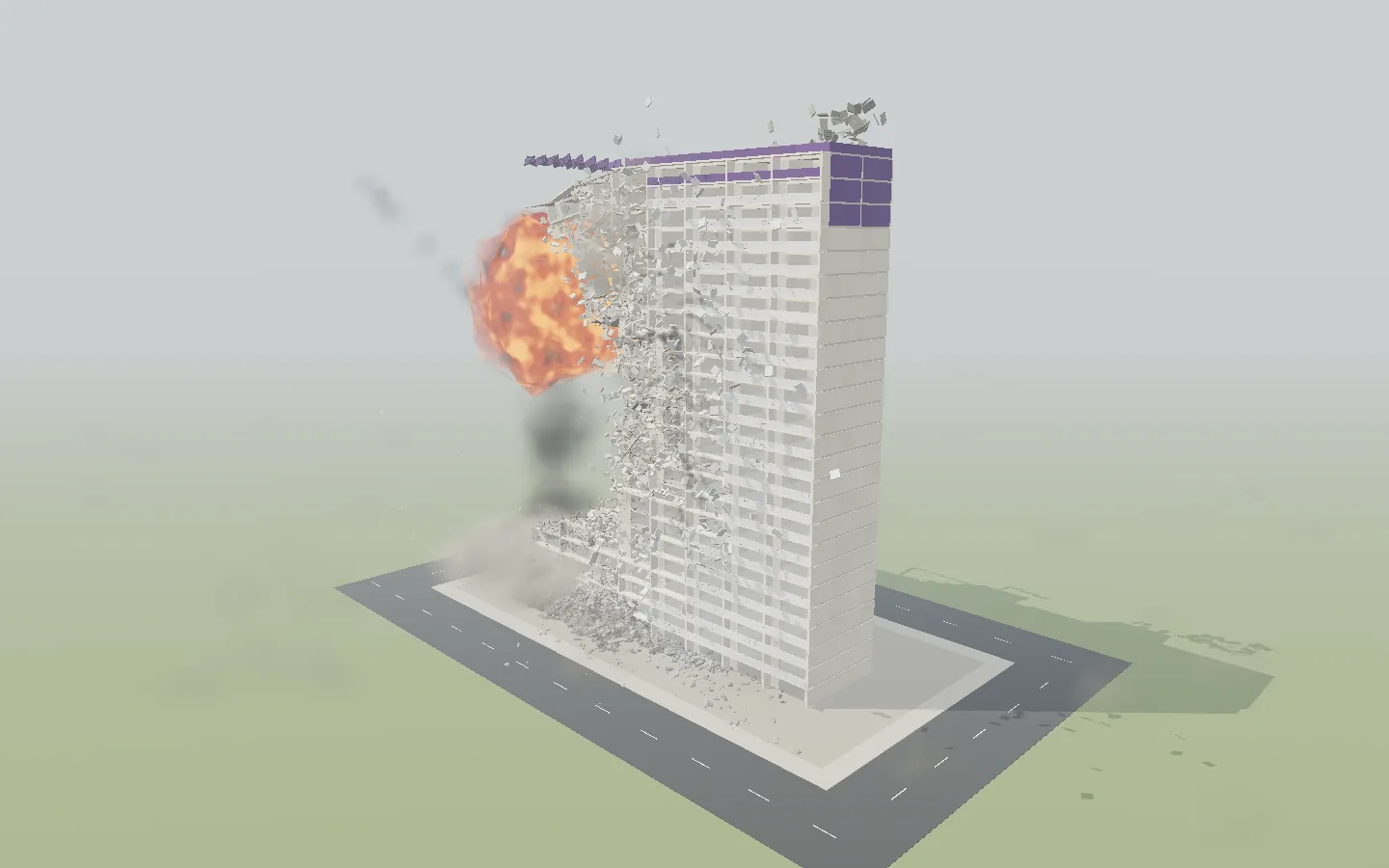
A building consists of hundreds or thousands of pieces connected by bonds. When the weight from above, an explosion, or an impact exceeds a bond’s limit, it breaks. Detached chunks become rigid bodies in the physics engine, tumble, and break again when they hit something else. A section whose center of mass moves beyond its support tips over as a whole. Spreading cracks, rolling dust clouds, breaking glass, and exposed reinforcement complete the scene. Sound is synthesized as you play, without audio files. These calculations are game approximations designed to make the collapse convincing, rather than real structural analysis.
What playtesting changed
I worked through the problems that appeared during play. Destroying only the columns made floors stack neatly like pancakes. Instead of releasing them all at once, I delayed more distant sections slightly and added a tilt so that the collapse looked less artificial. Sometimes the upper floors fell as one block and froze in midair; sometimes tiny fragments stayed floating after everything else had fallen. Both needed the same basic correction: unsupported pieces must fall. A repeating wave pattern on every cracked surface was replaced with irregular cells using Worley noise.
The controls changed too. Time bombs were rebuilt around pulling back and releasing to throw, with a dotted trajectory preview. The first mission was made manageable with two kegs. The wrecking ball was strengthened so the load from a broken column could transfer to neighboring columns and trigger a chain of failures. Firecrackers, kegs, and dynamite were added to the sequence planner for timed detonations.
What was in the first release
At the time of this October 4 diary, the game had ten buildings: seven homes and offices plus three stylized recreations of real landmarks. There were fifteen tools: five explosives, six weapons, and four methods—planning, toppling, air strikes, and earthquakes. Ten missions offered three stars each, for thirty stars in total. Free Play let you destroy a building and restore it with one button. The planner could hold up to twelve charges, with delays set in 0.1-second steps. Slow motion and four camera views were included. Quality was measured automatically at startup with lower-powered computers in mind, and the game also opened in mobile browsers.
Releasing on itch.io
Today, October 4, I uploaded the English edition to itch.io. It runs in the browser without installation and is free to play, with optional support for anyone who enjoys it. Some features specific to the EchoPlayroom website are omitted from the itch.io build.
If a building collapses strangely after a particular hit, or a control feels awkward, please let me know. That feedback helps shape the next revision.